
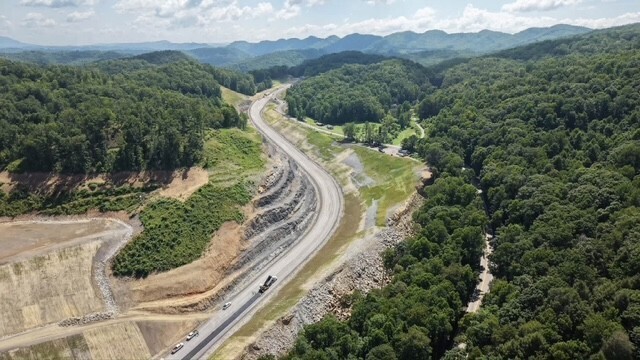
For Joey Mosley, the recently completed reconstruction of US 421 near the Virginia state line is much more than another highway project.
It is a piece of home.
Mosley grew up in Harlan County, attended Rosspoint Elementary School and graduated from James A. Cawood High School in 1994. More than three decades after beginning his journey in Harlan County, he found himself helping complete a long-awaited section of the very highway where his engineering career began.
With the opening of the reconstructed section of US 421 near the Virginia state line late last month, Mosley said seeing the project through from design to completion was “incredibly rewarding.”
“I’ve been blessed to work on an incredible number of projects throughout Kentucky,” Mosley said. “I’ve had leadership roles on projects such as the Mountain Parkway and the Brent Spence Bridge Corridor, and I’ve worked on every interstate and parkway in Kentucky. But there’s something extra special about having the opportunity to work back home.”
That connection to home is woven throughout Mosley’s career.
The Kentucky Transportation Cabinet began reconstructing US 421 in the late 1990s, and much of that work was completed by around 2004. But the approximately three-mile section leading toward the Virginia state line remained unfinished for years.
“When I was still with KYTC, we pushed hard to get that last section to construction, but funding limitations prevented the original project from moving forward,” Mosley said. “So, to come back years later and be part of the team that finally helped make it happen means a great deal to me personally.”
A CHALLENGING ROAD
Safe and reliable roads are vital to connecting Harlan County to the rest of Kentucky and the surrounding region. But the final section of US 421 presented some extraordinary challenges.
The terrain was difficult. The elevation changes were significant. The geology presented its own complications, with the project located along a fault and portions of the bedrock tilted at severe angles.
For the engineers designing the roadway, those conditions affected everything from stable cut slopes to the amount of earthwork required.
“This particular section of US 421 had some extremely challenging terrain and geometry, and our goal was to improve safety and mobility while developing a solution that could actually be constructed within the available funding,” Mosley said.
The project was not simply a matter of drawing a new road on a map.
Engineers had to find an alignment that improved roadway geometry and roadside recovery areas while minimizing excavation, slope-stability concerns and construction costs.
“Relatively small changes in an alignment can have a tremendous impact on excavation quantities, slope stability and ultimately construction cost,” Mosley said.
The team included geotechnical experts who worked alongside roadway designers during the development of preliminary alignments. Rather than waiting until an alignment had been selected to determine whether geological conditions would create problems, those risks were considered throughout the process.
That collaboration became one of the defining characteristics of the project.
A DIFFERENT APPROACH
In the winter of 2023, KYTC advertised US 421 as one of its first Progressive Design-Build projects.
The approach allowed KYTC, the contractor and the design team to develop the roadway solution and its cost together.
Unlike a traditional design-build process, where the price is generally established very early, Progressive Design-Build allowed the team to continually evaluate design decisions against actual construction costs.
“That was extremely important on this project because we could continually evaluate design decisions against actual construction costs,” Mosley said. “We didn’t have to guess whether something was constructable or what it might cost—the contractor was right there at the table evaluating those decisions with us.”
KYTC identified a budget of approximately $30 million to improve US 421 from the Virginia state line to approximately mile point 3 near Barn Branch.
That amount had to cover essentially everything—design, permitting, right-of-way, utility relocation and construction.
The first priority was the approximately 1.5-mile section from the state line, including an existing switchback curve that contained some of the most challenging geometry along the corridor.
The team studied numerous alternatives, including ways to incorporate portions of the original design.
Ultimately, a new alignment was developed that provided the best balance of roadway improvement, safety, constructability, geotechnical risk and cost.
“I think that’s really the story of this project,” Mosley said. “We weren’t simply trying to design the best road we could put on paper. We were trying to determine, together, how to use the funding KYTC had available to provide the greatest possible improvement for the people who travel US 421.”
FROM HARLAN COUNTY TO A CAREER IN ENGINEERING
Mosley’s connection to highway engineering began long before he returned to Harlan County to work on the latest US 421 project.
By the middle of high school, he already had a pretty good idea of the direction he wanted his life to take.
“I always loved to build things and solve problems,” Mosley said. “My grandfather was a carpenter, and I spent a lot of time getting in his way while he was building things. My dad was probably the best engineer I ever knew who wasn’t actually an engineer. He could fabricate just about anything and always seemed to be able to solve whatever problem was put in front of him. I think I picked up a lot from both of them.”
By high school, Mosley knew he wanted to pursue engineering. A family friend, Bill Clem, helped give him an opportunity to see the profession firsthand.
“By the middle of high school, I pretty much knew I wanted to pursue engineering,” Mosley said. “We had a family friend, Bill Clem, who helped me get my first summer job in the Harlan Resident Engineer’s Office, and from that point forward, I was hooked.”
That first opportunity would prove to be an important turning point.
Mosley attended the University of Kentucky and graduated from the College of Engineering in May 1999 with a bachelor’s degree in civil engineering.
That summer, he began his career with the Kentucky Transportation Cabinet in District 11.
Interestingly enough, his first assignment was in the Harlan County Resident Engineer’s Office—the same environment where he had first gotten a glimpse of highway engineering as a high school student.
“One of the first major projects I worked on was the reconstruction of US 421 at Grays Knob,” he recalled. “During my time there, I had the opportunity to work on each of the reconstructed sections of US 421 from Cranks to Grays Knob.”
Those projects involved major earthwork and gave Mosley an early foundation in highway construction.
He also spent time in the District 11 highway design office, experience that helped him understand both sides of project delivery—not only how a highway is designed, but how those decisions ultimately affect construction in the field.
He later became Resident Engineer for Whitley and Knox Counties, where he managed projects including the reconstruction of KY 92 and US 25W, along with multiple projects on I-75.
He also gained some of his earliest design-build experience before serving as District 11’s Transportation Engineering Branch Manager for Project Development from 2008 to 2013.
In that role, he oversaw the development of new construction projects throughout the district, from planning and environmental work through design, right-of-way and utilities.
Mosley joined HMB Professional Engineers in 2013, initially serving as Highway Division Manager. Today, he is a Senior Principal with the firm.
THE PEOPLE BEHIND THE PROJECT
For Mosley, the project was never simply about engineering.
Families have lived along the US 421 corridor for generations, and construction inevitably affects homes, property and daily routines.
“We worked hard to minimize those impacts where we could, maintain access, and be mindful of the people affected by the improvements,” he said. “We appreciate every property owner who worked with us and helped make this project possible.”
That perspective was especially meaningful to Mosley because he grew up in the community himself.
The project also depended on a broad team effort involving KYTC District 11 and Central Office staff, Bizzack Construction and HMB Professional Engineers.
“We had an incredible team working together,” Mosley said. “Everyone understood the challenges, the available budget and what we were trying to accomplish, and there was a real commitment to finding solutions rather than simply identifying problems.”
Project development began in late spring 2023. By that fall, the preferred alternative had been selected, while permitting, right-of-way acquisition and utility relocations moved forward alongside final design.
Construction began during the winter of 2025.
For a section of highway that KYTC had been trying to advance for more than 20 years, Mosley considers that remarkable.
Through Progressive Design-Build, the project moved from essentially a new concept to construction in about three years.
FINISHING WHAT WAS STARTED
There is another chapter of US 421 that Mosley hopes will eventually be written.
The 2026 Highway Plan includes additional design funding to address the remaining approximately 1.5 miles of the corridor toward Barn Branch.
“I’d certainly love to see the entire corridor completed, and I hope we have the opportunity to continue working with KYTC to make that happen,” Mosley said. “Given my history with US 421 and Harlan County, it would mean a lot to me personally to see that final piece completed.”
He also hopes the improvements on the Kentucky side will encourage continued interest in improving the corridor on the Virginia side.
For now, though, Mosley can look at the completed section of US 421 and see more than a roadway.
He sees a connection between where he came from, where his career took him and the opportunity to return home and make a difference.
A MESSAGE FOR THE NEXT GENERATION
Mosley’s story also offers a lesson for students who may be considering engineering—or who simply have not yet figured out where their own careers might take them.
“The demand for engineers in just about every discipline continues to be strong, and engineering provides incredible opportunities,” he said.
When Mosley was a student, he never imagined all the places his career would take him or the projects he would eventually work on.
He entered college with an emphasis in structural design and dreams of designing a major cable-stayed bridge.
His career took a different path.
Instead of becoming a traditional structural engineer, he gained experience in construction, highway design and project development.
Looking back, he said he is grateful his career developed that way.
“Having experience on both the design and construction sides taught me to look at a project as a whole—not just whether something works on paper, but whether it can actually be built and whether it solves the problem it was intended to solve,” Mosley said.
His advice to students is simple: find something that interests you and do not feel pressured to have your entire career figured out at 18.
“Engineering school is challenging, but you don’t have to be the smartest person in every class to become a good engineer,” he said. “You need to be willing to work hard, solve problems, learn from other people and keep going when something is difficult.”
For Mosley, engineering has ultimately been about more than calculations, plans and construction.
It has been about solving problems, working alongside talented people and creating something tangible that improves the lives of others.
“If you enjoy figuring out how things work, solving problems and being able to look back at something tangible and say, ‘I helped make that happen,’ engineering is a pretty rewarding way to spend a career.”
And for one James A. Cawood High School graduate, one of those tangible accomplishments now sits along the road that helped shape his career in the first place.
The road to Virginia became, in many ways, a road home.
+++++
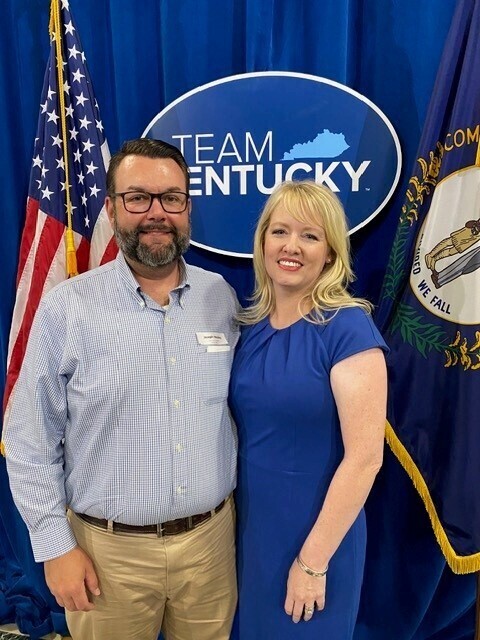
Mosley and his wife, Mary Bruce Mosley, reside in Frankfort with their sons, Elijah and Jacob. He is the son of Freda Mosley, a retired Rosspoint Elementary School teacher, and the late Joseph “Joe” Mosley, who worked in the coal industry for Consol Energy’s Jones Fork Complex in Knoxx County. His brother, Jonathan, lives in Henderson.
(CONSTRUCTION PHOTO COMPLIMENTS OF MR. ROBERT SCOTT)